A guide to what searches can establish about Canberra casino accommodation, gaming, dining and related services.

A Canberra casino hotel is a specific kind of property: the description implies both a casino and hotel accommodation are associated with the same venue. The wording alone does not establish that such a property operates in Canberra. Nor does it confirm that a casino has guest rooms, that a hotel is attached to one, or that rooms can be booked as part of a casino stay.
This distinction matters because the words “casino” and “hotel” can appear together in a heading, directory entry or travel description without proving that the advertised combination exists. A reference to a Canberra hotel and a reference to casino gaming are separate claims unless the property itself confirms the relationship. Treat them as separate until the details identify the venue and explain what it actually provides.
For the label to be useful, it should describe more than a hotel that happens to be discussed alongside a casino. It should identify a real accommodation property and establish that the casino and hotel are parts of the same venue or are otherwise formally connected. Without that distinction, “casino hotel in Canberra” could be read as a description of a single site even when the wording has not shown that.
If you’re looking for an online casino to consider from Canberra in 2026, this list gives you a starting point for checking each option against your own needs. Review the details that matter to you before choosing.
7Bit Casino
You can note that 7Bit Casino is licensed in Curacao and operated by Dama N.V.
SpinsUp
You can note that SpinsUp holds Curacao Gaming Control Board licence OGL/2023/174/0082 and is associated with Dama N.V.
Playfina Casino
You can consider Playfina Casino with its Curacao eGaming licence, held by Hollycorn N.V. since 2017. Its minimum deposit is A$20–30, depending on the offer.
Ricky Casino
Ricky Casino lists crypto payouts in under an hour and PayID payouts in 1–3 business days. The minimum deposit is A$20, or A$30 to qualify for the bonus.
Golden Pokies
You can note that Golden Pokies is licensed in Curacao; no other specific details are provided here.
Vegaz Casino
Vegaz Casino holds Curacao licence OGL/2024/1335/0780 and has a minimum deposit of EUR 20.
Neospin
You can note that Neospin holds Curacao Gaming Control Board licence OGL/2023/176/0095 and is associated with Hollycorn N.V.
JustCasino
JustCasino is listed with a Curacao Gaming Control Board licence; no further specific details are provided here.
Bizzo Casino
You can note that Bizzo Casino holds a Curacao Gaming Control Board licence and is associated with TechSolutions Group N.V.
SkyCrown
SkyCrown is licensed by the Tobique Gaming Commission. Its listed payout speeds are around 10–15 minutes for crypto and 1–5 days for fiat, with a minimum deposit of A$30.
The same caution applies to plural descriptions of casino hotels in Canberra. A plural category can sound like a list of established properties, but the phrase itself does not identify any property. A page title, map label or promotional description is not, on its own, enough to determine whether the venue has a hotel, whether it is operating, or whether the casino and accommodation belong together.
A hotel room is not implied merely because a venue is called a casino hotel. Room availability, room types and booking arrangements are separate details that require confirmation from the property. Likewise, a casino hotel deal suggests a particular offer, but the phrase does not tell you whether an offer exists, what it covers, or whether it is currently available. Do not treat the words “rooms” or “deals” in a description as proof of either.
A useful check is to look for information that connects the accommodation to the named property, rather than relying on the label alone. If the details do not clearly identify the hotel and its relationship to the casino, the description has not established that you are looking at an integrated casino-and-hotel venue. This is a limit on what the wording can support, not evidence that a particular property does or does not exist.
The reverse inference is just as unreliable. A hotel in Canberra does not become a casino because someone describes it as being associated with a casino, and a hotel listing does not confirm that casino gaming takes place there. Accommodation information and gaming information answer different questions. One may identify a place to stay; the other would need to identify a gaming venue. The shared use of a name or location does not settle the distinction.
The phrase “hotel near a Canberra casino” also describes a relationship that needs evidence: both the casino and the hotel must be identifiable, and the claimed proximity must be supported. A hotel result alone cannot establish the existence or location of a casino. Conversely, a casino-related mention does not show that accommodation is available at or near it. Keep these claims separate rather than allowing one to stand in for the other.
A reference to casino opening hours concerns access to a gaming venue, not the operating hours of a hotel or its reception. The two schedules need not be the same, and a hotel description cannot confirm when casino gaming is available. If a listing gives hours without clearly identifying the venue and what those hours apply to, it does not resolve the question.
For a Canberra casino hotel search, the careful reading is therefore narrow: the phrase expresses interest in accommodation connected with casino gaming. It does not, by itself, verify a casino hotel, guest rooms, a hotel deal, nearby accommodation or casino opening hours.
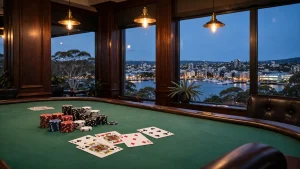
A poker room and a room of poker machines are different things. A poker room is a place where people play poker against one another, often at organised tables or in scheduled tournaments. Poker machines, also called Electronic Gaming Machines (EGMs), are individual gambling devices; playing one does not mean that a venue runs poker tables or poker competitions.
That distinction matters when you are trying to establish whether poker is available at a Canberra venue. A reference to gaming, machines or a casino does not, by itself, tell you whether there is a poker room. Nor does a poker-room listing confirm that tournaments are running on a particular day. A tournament schedule is a separate operational detail: dates, registration arrangements and table availability can change, so confirm them with the venue before travelling.
Canberra is in the Australian Capital Territory, not New South Wales. Rules or venue information that apply in NSW should not be presented as though they govern Canberra. For example, NSW has a legal gambling age of 18 for poker machines and a mandatory pre-commitment system under which players set a loss limit before playing. Those are NSW-specific details; they do not establish the rules for a Canberra poker room or for gambling in the ACT.
The same geographical distinction applies to claims about poker machines at particular clubs. Club Liverpool has the highest number of operational poker machines among clubs in NSW. That fact says nothing about poker tables, tournament availability or machine numbers in Canberra. It is not a basis for comparing Canberra venues or inferring what facilities they provide.
When checking a poker listing, look for wording that identifies the activity precisely. “Poker room” suggests table poker, while a tournament notice should specify that an organised competition is taking place. A page mentioning gaming machines is not evidence of either. If a listing uses broad language, ask whether it refers to live poker, a scheduled tournament or only machine gaming. This prevents a venue category from being mistaken for a confirmed service.
The word “rooms” can also refer to accommodation rather than a place to play poker. Treat those as separate questions: a hotel-room listing does not establish a poker room, and a poker-room reference does not establish that accommodation is available. Similarly, a venue’s general opening status would not tell you whether a poker table or tournament is operating at that time. For a planned visit, confirm the specific poker activity and its schedule rather than relying on a general description.
If you are comparing options, keep the evidence attached to the claim it supports. A tournament announcement can support a claim about that event, but not a claim that poker is available every day. A machine count cannot establish that live poker is offered. And NSW information cannot fill a gap in ACT venue details. These distinctions help you assess what a listing actually confirms before you arrange a trip or make plans around a game.
A request for baccarat or craps is a question about a particular game, not proof that a Canberra venue offers it. The same distinction applies to a bar, car park or concert programme: a phrase used to describe a place does not establish that the facility or event is available. Treat each detail as a separate point to confirm rather than assuming that one casino-related listing answers them all.
Baccarat and craps are distinct table games, so a listing for one would not confirm the other. Nor would a general reference to casino gaming tell you which games are offered, whether tables are operating, or what conditions apply. If a venue is identified, look for a current, venue-specific description that names the game. A generic directory entry or an old mention may describe a different place or an earlier arrangement.
This matters particularly when you are comparing a specific game with a broad claim such as “casino games.” The broad label leaves the details unresolved. It does not identify baccarat, craps, or any other game, and it should not be read as a promise that a particular table is open.
A casino bar is an on-site service question. A car park is an access and parking question. Concerts concern an event programme. None follows automatically from the word “casino,” and confirmation of one would not settle the others. For example, a venue’s event listing would not establish that it has a bar, while a parking reference would not tell you whether a concert is scheduled.
When checking a listing, match the detail to the decision you need to make. For a bar, establish that the bar belongs to the venue rather than being nearby. For parking, distinguish an on-site car park from street or third-party parking. For a concert, check the event’s venue and date directly; a past performance does not establish a current programme. These distinctions prevent a nearby service, historic event or general directory category from being mistaken for a current venue amenity.
A map pin can help locate an address, but it does not by itself confirm that the marked property is a casino or that a listed facility is inside it. Check that the map label, address and venue name agree. If a result gives a contact number, verify that it is attached to the same place before relying on it; a number copied into a directory may refer to another business or an outdated listing.
The useful test is consistency across details. A venue name, address, map location and contact channel should point to one identifiable business. If they do not align, the information is not enough to plan a visit or assume that games, parking, a bar or an event are available there. A current, direct venue notice is more useful for a specific facility than a broad category label.
These checks keep the meaning of each detail intact. “Baccarat” and “craps” name games; “bar,” “car park” and “concert” name separate services or events; a map and phone number help identify a location. None of these labels, on its own, confirms the others.
An online casino’s game catalogue is not necessarily identical for every visitor. A platform or software provider can restrict access according to the country it believes a player is in. The location check can therefore affect whether a game appears in the lobby at all, rather than merely whether it can be started.
Legal Restriction
Using a VPN to access region-blocked pokies sites is against the service’s terms and may lead to account suspension.
The basic mechanism uses your internet protocol (IP) address. When you connect, the service can use that address to estimate your geographic location and compare it with its access rules. If the address is associated with Australia and a game or provider is blocked for that region, the affected titles may be left out of the lobby. You can then search for a title and find no result, even though it exists in the wider catalogue.
A missing title is not the only possible outcome. A game that is visible in a lobby may fail to load if a region restriction is applied when you try to open it. A specialist review has described that kind of loading failure as a possible result of regional blocking; it should not be treated as proof that every loading error has the same cause. Connection problems or other technical faults can also prevent a game from opening.
The distinction matters when you are trying to understand an online casino service associated with Canberra. A location-sensitive catalogue does not confirm that a Canberra venue operates an online casino, nor does it establish that online casino games are available to people in Australia. It describes how an online platform may respond to the location it detects. The availability of a particular game can depend on the platform’s and provider’s restrictions, not simply on the player’s preference or the game’s presence elsewhere.
A virtual private network (VPN) can change the IP address presented to a service, so the apparent digital location may differ from the player’s physical location. A specialist review has described this as a way a person in Australia might appear to connect from another country. That technical effect is not permission to bypass a restriction. Using a VPN to access region-blocked pokies sites is against the service’s terms and may lead to account suspension. The service may also detect or reject the connection.
For a practical diagnosis, first separate a catalogue restriction from a general fault. If a title is absent while other parts of the lobby work, regional availability is one possible explanation. If a visible game will not load, a region rule is one possibility among several; the symptom alone does not identify the cause. Neither changing networks nor trying to disguise your location establishes that access is authorised.
These checks explain why an online result can differ from one country to another, but they do not make online casino play an appropriate option for Australians. The Interactive Gambling Act 2001 restricts operators based in Australia from providing real-money online casino games to people in the country. Offshore services are not regulated under Australian law. Location-based blocking is an access control, not a substitute for understanding the legal and account conditions that apply.
A room at a casino hotel and a room near a casino are different things. The first means accommodation operated as part of the venue; the second means a separate property within a useful distance. A phrase linking Canberra, a casino and accommodation does not establish which arrangement exists. Before comparing places to stay, identify the destination you intend to visit and confirm that it is a physical venue with a usable location.
Comparing Accommodation
Confirm the destination
Identify the specific physical venue you intend to visit and confirm its usable location.
Verify property details
Confirm the accommodation’s name, address, room type, and booking conditions on the property’s own page.
Calculate the journey
Compare the route between the accommodation and the destination to ensure it is practical for your transport.
That distinction matters because “near” is not a fixed distance. A property may look close on a map but require a longer journey by road, while another may be easier to reach on foot or by public transport. Once you have a confirmed destination, compare the route from each accommodation option rather than relying on the wording of a listing. Check whether the route is practical at the time you expect to travel and whether it depends on transport that is available to you.
A useful comparison starts with the property, not with a casino-related label. Confirm the accommodation’s name, address, room type, total price and booking conditions on the property’s own booking page or with the provider. Then check the destination independently and calculate the journey between the two. If either location cannot be pinned down, the proximity claim cannot be assessed reliably.
Be precise about what a booking includes. A room advertised near a casino is not necessarily part of a casino, and the wording does not imply access to venue facilities or services. Likewise, a hotel offer does not become a casino promotion simply because both appear in the same search results. Treat accommodation prices and gaming offers as separate products, each with its own terms and provider.
The same separation applies to offers described as deals. Compare the final price and the conditions attached to the room, including what is included and what happens if you change or cancel the booking. A promotional label alone does not show that the accommodation is cheaper or that it is connected to a casino. Confirm the offer with the business responsible for the booking rather than assuming that a venue or third party will honour it.
Parking is another location question, not a detail that can be inferred from proximity. If you plan to drive, confirm parking arrangements directly with the accommodation provider and consider the route to your destination. A nearby property may not provide parking, and a parking facility may not be available to every guest. Do not treat map symbols or general listing descriptions as confirmation of access.
For a practical shortlist, record the confirmed destination, each property’s location, the travel route, the full booking price and any conditions that affect your stay. This prevents a hotel listing, a nearby lodging option and a casino-related offer from being treated as interchangeable. It also makes it clear what you still need to confirm before paying: the property itself, its actual location and the specific terms of the reservation.
Breakfast and buffet terms can make a venue sound like a hotel or resort, but those labels do not establish what operates in Canberra. A search for breakfast at a casino, a buffet breakfast, or a casino resort may reflect an expectation about dining or lodging; it is not confirmation that a Canberra casino provides those services. The same applies to a buffet described without specifying breakfast. Treat each as a separate facility claim that needs direct confirmation from the venue before you plan around it.
“Resort” is also a broad description, not proof of a particular property or package. It can refer to accommodation, dining, leisure facilities, or a combination of services. A casino-related result using that term does not, by itself, verify that a Canberra venue is a resort or offers a resort package. Do not infer amenities from the label alone.
Rewards require a different distinction. A venue loyalty programme would be a facility or scheme attached to that venue; online free-spin promotions are not evidence of such a programme. Their terms concern promotional play and withdrawal conditions, not points, membership benefits, or rewards earned at a physical casino.
The terms attached to online free spins can include a wagering requirement: winnings may need to be played through before withdrawal is permitted. One report on promotional terms described requirements in a range from 20 to 50 times the winnings; a specialist review separately reported a 30-times requirement. These are attributed reports, not a universal rule or a current Canberra venue policy. Conditions can differ, so a headline offer cannot tell you the applicable requirement. Promotional terms may also include high wagering requirements, maximum cashout limits, or clauses under which winnings can be voided. Those are reasons to read the full conditions, not reasons to treat an online promotion as a casino rewards programme.
Australian law draws an important boundary around this comparison. The Interactive Gambling Act 2001 prohibits operators based in Australia from providing real-money online casino games to people in Australia. An online free-spin offer therefore should not be read as confirmation of a lawful Canberra casino loyalty scheme or as an invitation to play online.
Employment searches raise another distinct issue. Results about jobs at a casino may point to vacancies, recruitment pages, or other material, but the wording alone cannot establish that a particular Canberra casino exists or is hiring. Check the employer and the location stated in any listing before relying on it. A job title or search result is not evidence of breakfast service, buffet dining, a resort operation, or a rewards programme.
For practical planning, separate the claims: confirm whether a named venue exists, then confirm the specific service or employment opportunity with that venue. A breakfast listing does not verify a buffet; a resort label does not establish a casino; and online promotion terms do not describe on-site rewards.
Opening times, reopening announcements and event listings answer different questions. A stated opening time is a schedule for a particular date; it does not establish that a venue is operating now or that the schedule will remain unchanged. An event listing is narrower still: it relates to a named programme or date, not necessarily to the venue’s usual hours. If you are checking whether a Canberra venue is open or hosting an event, look for a current notice issued by the venue and check that its date applies to your visit.
Development announcements and employment listings also need to be read for what they establish. A proposal or construction update concerns a possible project, while a job advertisement indicates recruitment for a stated role; neither, by itself, confirms that a casino is open to the public. A review records an assessment at a particular time and should not be treated as a current operating notice. These distinctions matter because several different kinds of information can appear under the same venue name.
Online casino games are a separate issue from the operation of a physical venue. The Interactive Gambling Act 2001 makes it unlawful for an operator based in Australia to provide real-money online casino services to people located in Australia. The restriction covers games such as pokies, blackjack and roulette. A reference to a casino’s opening hours or events therefore says nothing about whether an online casino service may lawfully be offered to Australian residents.
Attention The Interactive Gambling Act 2001 makes it unlawful for an operator based in Australia to provide real-money online casino services to people located in Australia.
Offshore platforms are not regulated under Australian law. Although Australian players are not themselves prohibited from using such platforms, that does not give the platforms Australian regulatory oversight or the protections associated with a locally regulated provider. It also does not make an offshore operator an Australian casino. Keep the legal status of the operator distinct from the question of whether a physical venue is open, holding an event or recruiting staff.
For a practical check, match each detail to the decision it supports. Confirm an opening notice against the date you plan to attend; treat an event announcement as applying only to the event it names; and read development or recruitment material as evidence of a project or vacancy, not as proof of public access. A review can help describe someone’s past experience, but it cannot replace current operational information. These checks concern a physical venue. They do not alter the Interactive Gambling Act’s restrictions on online casino games offered by Australian-based operators.
An address is the first detail to verify before planning a visit, but a location attached to a general “Canberra casino” label is not enough on its own. Check that the address appears on the official website of the named venue and matches its current contact details. Map listings and directory pages can help with orientation, but they should not be treated as proof that a venue operates at that location. If the listing does not identify an operator, you cannot reliably connect it to entry instructions, services or employment contacts.
The same distinction matters for dress codes. A casino’s name or setting does not establish what clothing is permitted. If you are visiting a specific venue, look for its own entry policy, including any rules that apply to particular areas or events. When no policy is published, contact the venue before travelling rather than relying on assumptions about what “smart” or “casual” means. A rule can be venue-specific, and a general description may not answer whether a particular item is acceptable.
Spa searches need similar care. A request for a Canberra casino day spa may refer to a spa inside a casino, a separate business nearby, or simply a facility someone expects to find there. Those are different arrangements. Confirm the business name and address, then check whether its own information describes the service and how access or bookings work. A spa mentioned in a directory or a third-party listing should not automatically be treated as an on-site casino amenity.
Career listings also need to be tied to an identifiable employer. A role advertised under a broad casino-related label may belong to a venue, a contractor or another business. Check the employer named in the listing and follow the application route provided by that organisation. This helps separate genuine venue vacancies from unrelated roles that share similar wording.
These checks are useful because address, entry rules, spa services and employment are separate operational details. Confirmation of one does not establish the others: a listing may identify a location without explaining access, or describe a business without showing that it is part of a casino. For any Canberra venue, rely on information issued by the organisation responsible for the specific service you intend to use.
A casino and a restaurant are separate things to verify. A reference to a casino in Canberra does not, by itself, establish that a restaurant operates there. Nor does a restaurant listing that uses a casino’s name prove that it is inside the venue: it could refer to a nearby business, an old listing or a proposed development.
If you are trying to identify a restaurant within a Canberra casino, look for details that connect the two directly: the restaurant’s own name, an address or location inside the venue, and current information from the business or venue operator. A menu can help confirm what the restaurant serves, but it cannot establish that the restaurant is part of a casino unless the location is clear. Treat the dining listing and the venue listing as distinct until that link is explicit.
The same distinction applies when comparing casino restaurants in Canberra. A list of businesses described as “near” a casino does not show that they are operated by it or located inside it. Check the stated address and the wording used to describe the relationship. “Near” indicates proximity; “at” or “inside” makes a different claim and needs support from the listing itself.
A rooftop bar is also not interchangeable with a restaurant. The label may indicate a bar, a dining space, or both, but the name alone does not establish which services are offered. If a rooftop setting matters to your plans, look for a current description that identifies the space and its food service rather than inferring a restaurant from the word “bar.”
Before travelling, confirm that the restaurant is currently operating and check its own published details for the location and menu. Opening arrangements and menus can change, so an old directory entry may not reflect what is available now. If the listing does not make the venue relationship clear, contact the business or operator directly rather than treating the shared name as confirmation.
This approach keeps the central question precise: not simply whether a restaurant appears in a Canberra casino-related listing, but whether a named restaurant is actually located at the casino and provides the dining service you intend to use.
Food service and a swimming pool are separate facilities, so a general reference to dining or recreation would not establish that either is available at a particular casino. If you are checking whether a Canberra venue has food on site, look for a current listing that names the outlet and identifies where it operates. A food court is a more specific claim: it implies a shared area with food vendors, not simply a restaurant or bar serving meals.
The distinction matters when planning a visit. A venue page that mentions dining may describe one outlet, a seasonal service or an arrangement elsewhere; it does not by itself confirm a food court. Check the venue’s own current information for the exact service, location and any stated access conditions before relying on it.
A pool also needs a precise description. A listing might refer to a public facility nearby, a pool attached to another business, or a feature available only to a defined group. Those are not interchangeable with a pool that casino visitors can use. Look for an explicit statement identifying the facility and who may access it, rather than inferring access from a broad leisure or resort description.
If the information is unclear, contact the venue directly and ask about the specific facility and access arrangements. This avoids treating nearby food businesses or recreation facilities as part of the casino itself. It also helps distinguish a confirmed service from a name or description that could refer to a different place.
For Canberra, treat food outlets, a food court and a pool as individual details to confirm for the exact venue you intend to visit. A general label such as “casino dining” or “leisure facilities” is not enough to establish what is on site or available to you.