Stellar Spins payment methods in Australia
 Available in AU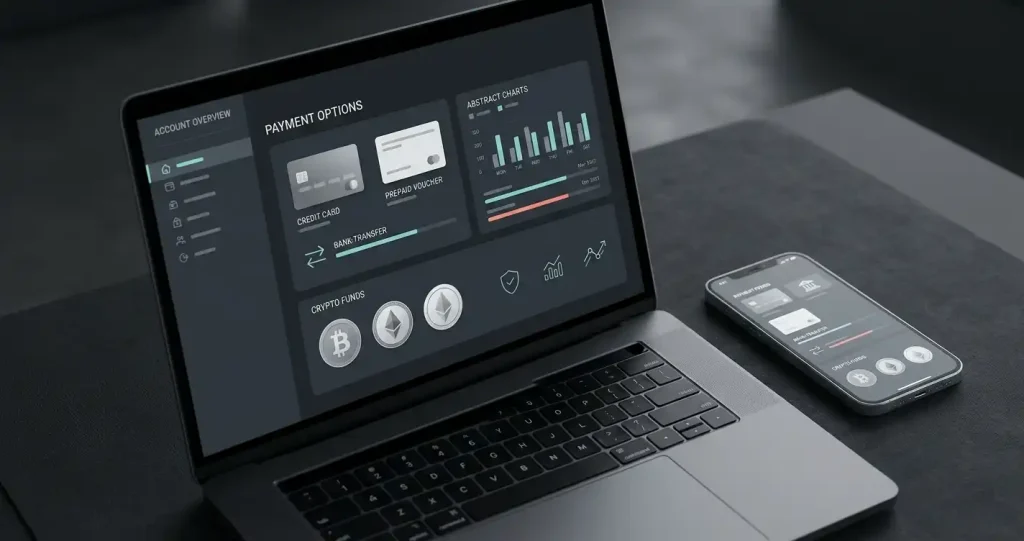
Stellar Spins uses a hybrid payments model: conventional fiat rails sit alongside six named crypto deposit assets. Visa, Mastercard and Neosurf appear among the listed fiat options, while bank-transfer and e-wallet routes are also presented. For crypto deposits, the named assets are Bitcoin, Bitcoin Cash, Ethereum, Litecoin, Dogecoin and XRP. Check the funding method, account currency and eventual cashout route separately.
Table of Contents
- Deposit costs depend on more than the casino fee line
- Reversibility changes the risk of a payment mistake
- The payment mix combines fiat rails with six named crypto assets
- USDT is presented two different ways in the current payment material
- Funding and cashout should be treated as separate routes
- Questions about Stellar Spins payments
- Funding, denomination and cashout need to align
Deposit costs depend on more than the casino fee line
Stellar Spins says it does not charge a deposit fee. That statement describes the casino-side charge, not every cost that can occur before funds reach an account. A card issuer can apply its own treatment to a gambling transaction, a bank can apply transfer charges, and a crypto transfer can incur a network fee. Those costs come from different parts of the payment chain, so a zero casino deposit fee does not automatically mean a zero-cost deposit.
The casino also states a $10 general minimum deposit. Treat $10 as the general account-level minimum, not as a guarantee that every payment method has identical rules. Payment processors can impose their own transaction rules, and crypto deposits introduce an additional layer because the network and destination address must match the asset being sent. The amount entered in a cashier is therefore only one part of the funding decision.
For fiat, the cleanest comparison is between reversible and less-reversible rails. Card payments can involve issuer controls and familiar statements, while prepaid funding such as Neosurf separates the casino transaction from a main bank card. Bank or e-wallet routes add another intermediary with its own timing and account rules. The casino lists AUD, CAD, EUR and NZD as supported fiat account currencies, so denomination matters as much as payment method: unnecessary currency conversion can create a cost even when the casino itself lists no deposit fee.
Reversibility changes the risk of a payment mistake
Fiat and crypto deposits expose the player to different failure modes. A mistyped crypto address or an incompatible network can make a transfer irreversible, while a card or bank transaction generally leaves a clearer record inside a regulated payment system. That does not make one route universally preferable; it changes what must be checked before money moves.
For crypto, the asset name alone is not enough. Bitcoin, Bitcoin Cash, Ethereum, Litecoin, Dogecoin and XRP are distinct assets with different address formats and transfer mechanics. Stellar Spins does not provide a fixed network list in the payment information used here, so the receiving payment dialog is the place where the applicable route has to be matched. A transfer should use the exact asset and destination details presented for that transaction rather than assuming that a ticker implies a particular alternative network.
For fiat, account currency deserves the same attention. If the player holds AUD but funds an account denominated in another supported currency, conversion can occur before or after the casino transaction depending on the provider. The cost may then appear as an exchange-rate spread or issuer charge rather than a casino fee. That is why AUD, CAD, EUR and NZD should be read as account-currency options, not as a guarantee that every listed method processes every currency on identical terms.
The same distinction carries into cashout. Deposit support does not automatically prove that the identical rail is available for withdrawal. For cashouts, check the withdrawal limits and timing, including minimums, the weekly cap, processing time and the conflicting crypto-withdrawal information.
The payment mix combines fiat rails with six named crypto assets
The crypto side of the payment set is broad enough to cover several major asset families. Do not infer a network or cashout route from the coin name alone. If the network is not specified, check the casino’s payment dialog before sending crypto.
| Coin | Network | Min Dep | Min WD | Speed | Fee |
|---|---|---|---|---|---|
| Bitcoin (BTC) | Payment dialog | — | Withdrawal guide | — | Network fee can apply |
| Bitcoin Cash (BCH) | Payment dialog | — | Withdrawal guide | — | Network fee can apply |
| Ethereum (ETH) | Payment dialog | — | Withdrawal guide | — | Network fee can apply |
| Litecoin (LTC) | Payment dialog | — | Withdrawal guide | — | Network fee can apply |
| Dogecoin (DOGE) | Payment dialog | — | Withdrawal guide | — | Network fee can apply |
| XRP | Payment dialog | — | Withdrawal guide | — | Network fee can apply |
The fiat side is more familiar. Visa and Mastercard cover the main card rails, Neosurf provides a prepaid route, and bank-transfer or e-wallet options add non-card funding paths. The listed fiat account currencies are AUD, CAD, EUR and NZD. Compare denomination separately from rail type because the currency held in the account and the payment mechanism solve different parts of the transaction.
- Cards: Visa and Mastercard provide conventional card funding with issuer-level transaction records.
- Prepaid: Neosurf separates the casino deposit from a primary payment card balance.
- Bank or e-wallet: the route adds another provider whose transfer rules can affect timing and charges.
- Crypto: BTC, BCH, ETH, LTC, DOGE and XRP require asset and destination details to match exactly.
Payment choice can also affect account verification. The casino asks for government-issued ID, recent proof of address and, where applicable, a payment-card copy. Check the verification requirements before funding an account, especially when a payment-card copy may be requested.
USDT is presented two different ways in the current payment material
The current Stellar Spins homepage payment table lists USDT. The dedicated crypto FAQ says the casino does not accept stablecoins. The casino therefore presents USDT availability in two incompatible ways. USDT is kept separate from the six crypto assets that appear consistently across the payment material.
That matters because a stablecoin ticker can look deceptively simple. In practice, a stablecoin transfer also depends on the network and receiving address. Even when a casino presents a stablecoin in a payment table, the player still needs a compatible deposit route for the exact asset and chain. Here, the conflict is earlier than that: one current page displays USDT while another rules out stablecoins.
The six crypto deposits that appear consistently enough to describe directly are BTC, BCH, ETH, LTC, DOGE and XRP. For those assets, the main operational risk is transfer finality. Crypto values can move between funding and later disposal, and blockchain transfers can be irreversible. A mistaken destination or unsupported route can therefore create a loss that is structurally different from a declined card payment.
- Match the asset ticker to the receiving destination presented for the transaction.
- Check the network details shown with that destination rather than assuming a chain from the coin name.
- Allow for an external network fee when comparing the amount sent with the amount available after transfer.
- Keep the transaction identifier so the transfer can be traced if account crediting becomes disputed.
Funding and cashout should be treated as separate routes
A deposit method answers how money enters the account; it does not by itself establish how money leaves. That distinction is especially important at Stellar Spins because its current crypto-withdrawal information is presented differently across its own pages. Check withdrawal rules separately; a crypto deposit option does not guarantee a matching crypto withdrawal route.
For payment planning, this means the deposit choice should be read alongside the eventual verification and cashout requirements. A player using a card may later be asked for a card copy where applicable. A player funding with crypto still has to consider the account’s verification process and the available withdrawal route. The payment method is one stage of the account lifecycle, not a shortcut around it.
Game selection is independent of the payment rail. Slots, live casino, table categories and providers do not change because a crypto deposit is used. A payment feature also says nothing by itself about game fairness, withdrawal reliability or account policy.
Start with the funding route, the account currency and the transaction record provided by the payment service. Then check the cashout route separately. This reduces the chance of discovering only after play that the entry rail and exit rail operate under different constraints.
Questions about Stellar Spins payments
Which payment methods does Stellar Spins list?
Stellar Spins lists Visa, Mastercard, Neosurf and bank-transfer or e-wallet options for fiat funding, plus Bitcoin, Bitcoin Cash, Ethereum, Litecoin, Dogecoin and XRP for crypto deposits.
Which account currencies are listed at Stellar Spins?
The listed fiat account currencies are AUD, CAD, EUR and NZD.
Does Stellar Spins accept USDT?
The current homepage payment table lists USDT, while the dedicated crypto FAQ says stablecoins are not accepted. The casino therefore presents USDT availability in two incompatible ways.
Does Stellar Spins charge a deposit fee?
Stellar Spins says it does not charge deposit fees. Crypto transfers can still carry network costs outside the casino, so the amount sent and the amount credited can be affected by the transfer route.
Funding, denomination and cashout need to align
Stellar Spins combines familiar fiat rails with six named crypto deposit assets and four listed fiat account currencies. There is no universally best payment method. Check the funding rail, denomination, transfer reversibility, verification requirements and eventual cashout path before choosing one. The USDT presentation is a clear example of why a payment label should not be read in isolation from the detailed route behind it.