Bitcoin is the payment method, while the slot game and its credits operate separately; the guide also covers payments and account disputes.

Bitcoin pokies are digital slot-machine games that accept Bitcoin as a payment method. The game itself runs online: you select a game, make a play using its interface and receive the result on screen. Bitcoin is relevant to the money used around the game, not to how its reels or other game features operate. The game and the payment system are separate parts of the experience.
There are two distinct ways online pokies may be offered: free play and real-money play. Free play lets you use game credits without staking Bitcoin for a cash result. Those credits are for playing the game and should not be treated as Bitcoin or as a balance that can be withdrawn. Real-money play involves value being put at risk. A displayed game balance in that setting represents credits used by the game; it is not necessarily shown directly as a Bitcoin amount.
Keeping those balances separate helps explain what you are looking at. Bitcoin is a cryptocurrency held in a wallet, while game credits are units used within a particular game. The interface may display a balance in credits, Bitcoin, or another unit, depending on its design. A credit figure alone does not tell you how much Bitcoin it represents. The conversion can depend on the game and the current Bitcoin price; a specialist review has described this relationship, but it should not be assumed to work identically across games or services.
If you’re looking for bitcoin pokies in Australia in 2026, use this list as a starting point and check each casino’s current payment options before signing up. The details below highlight only the information available for each operator.
7Bit Casino
7Bit Casino is operated by Dama N.V. and is licensed in Curacao.
SpinsUp
SpinsUp is operated by Dama N.V. and holds Curacao Gaming Control Board licence OGL/2023/174/0082.
Playfina Casino
Playfina Casino has operated under Curacao eGaming through Hollycorn N.V. since 2017. Its minimum deposit is A$20–30, depending on the offer.
Ricky Casino
Ricky Casino lists crypto payouts in under an hour and PayID payouts in 1–3 business days. The minimum deposit is A$20, or A$30 to qualify for the bonus.
Golden Pokies
Golden Pokies is listed as licensed in Curacao.
Vegaz Casino
Vegaz Casino holds Curacao licence OGL/2024/1335/0780. Its minimum deposit is EUR 20.
Neospin
Neospin is operated by Hollycorn N.V. and holds Curacao Gaming Control Board licence OGL/2023/176/0095.
JustCasino
JustCasino is listed as licensed by the Curacao Gaming Control Board.
Bizzo Casino
Bizzo Casino is operated by TechSolutions Group N.V. and is licensed by the Curacao Gaming Control Board.
SkyCrown
SkyCrown is licensed by the Tobique Gaming Commission. Its listed payout times are around 10–15 minutes for crypto and 1–5 days for fiat; the minimum deposit is A$30.
For someone seeking to understand the real-money setup, the first part is obtaining Bitcoin. Cryptocurrency exchanges are one route: they allow users to buy Bitcoin with conventional currency. The exchange’s own account and purchase process is separate from any gaming account. Buying Bitcoin does not automatically create a game account or put funds into one.
An exchange may ask for basic information and require you to set a password. Those steps establish access to the exchange account; they do not establish an account with a separate gaming service. Keep the distinction clear because each account has its own credentials and controls. A password used for one account should not be assumed to secure another.
A gaming account, where offered, is created through the service’s registration process. This commonly involves entering basic information and setting a secure password. The account is the place where the service associates your access to games and its internal balance. It is not the same thing as a Bitcoin wallet: the wallet holds or manages Bitcoin, while the gaming account records activity within the service. The exact information and procedures required can differ between services.
At a conceptual level, real-money participation therefore involves several separate components: Bitcoin acquired through a cryptocurrency exchange, a wallet that can hold or send it, an account with the gaming service, and the game’s own credit display. Treating them as a single balance can lead to confusion. A number shown in a game does not, by itself, explain whether it is a free-play credit, a real-money credit, or a direct Bitcoin amount.
 Casino Dice Games in Australia: Rules and FormatsLearn how casino dice games differ from ordinary dice games and how rolls work within their rules. A result may determine an…
 Australian Online Pokies: New Games and Legal LimitsLearn why offshore “new pokies” rankings cannot be verified, how Australian rules treat real-money casino services, and what to check around verification…
Free play avoids the need to stake Bitcoin in the game, but it does not make the two modes interchangeable. A free-play balance is not evidence that a real-money balance is available, and game results in free mode do not establish what a real-money session would involve. If real money is involved, you must be at least 18 years old.
This description explains the components, not a recommendation to open an account or participate. Bitcoin and game credits are different forms of value, and the interface determines how the latter are represented. Before interpreting any balance, identify whether the game is in free-play or real-money mode and what unit its display uses. That distinction is the basic mechanism behind Bitcoin-based pokies.
This page is affiliate material and may include sponsored links.
The legal position depends on where the player is located and where the service is provided. Under the Interactive Gambling Act 2001, providing real-money online casino games to people physically in Australia is illegal. The prohibition covers casino-style games such as pokies, poker, blackjack and roulette. A company cannot make that service lawful for Australian residents simply by accepting Bitcoin or operating a website from another country.
Legal Prohibition
Under the Interactive Gambling Act 2001, providing real-money online casino games to people physically in Australia is illegal, regardless of the payment method used.
This also explains why the phrase “locally licensed online casino” does not describe a legal route to real-money pokies in Australia. Australian law prohibits locally licensed online casinos from offering those games to residents. The restriction concerns the provision of the service; it is not changed by the payment method, the website’s language or the location of its servers.
The offshore operators discussed in connection with Bitcoin pokies Australia hold licences issued outside Australia, primarily from Curacao eGaming or the Anjouan Gaming Authority. An overseas licence is not an Australian licence and does not displace Australian law. It indicates the jurisdiction under which an operator says it is licensed, not that the operator is authorised to provide real-money casino games to people in Australia.
The distinction matters because a licence is not a universal guarantee. A foreign regulator’s authority and rules are separate from Australian law, and Australian consumer protection laws do not apply to these offshore operators. If a dispute arises, an Australian player cannot assume that domestic consumer protections will govern the operator or provide a local remedy. The presence of a licence name on a site does not change that jurisdictional limit.
Australian law also addresses the providers of prohibited interactive gambling services. The maximum daily penalty under the Act is $360,000 for an individual and $1.8 million for a body corporate. These figures concern legal penalties, not a fee a player must pay for using a site. The relevant legal prohibition is on operators providing the service to people in Australia.
 Aristocrat Online Pokies in Australia: What It MeansThis article distinguishes game associations from online availability and separates free play from real-money play, showing what the search wording cannot verify.
 Pokie Machines in Australia: How to Choose and PlayLearn how Australian rules treat online pokies, what RTP and demo play can show, and why an offshore licence does not make…
Offshore availability should not be mistaken for local approval. Access to such services is actively blocked and enforced in Australia. A website appearing in a search or loading at a particular moment does not establish that its operation is lawful, that it is locally regulated, or that an Australian authority supervises a player’s account. Nor does the use of cryptocurrency create a separate legal category for casino games.
There is a separate practical risk when transferring cryptocurrency. A blockchain transaction sent to the wrong address is generally irreversible, so the funds are generally unrecoverable. The destination address must therefore be treated as an exact instruction, not as a detail that can be corrected after sending. This risk exists independently of the operator’s foreign licence or the legality of the gambling service. A payment can be technically completed on the blockchain while still reaching an unintended address.
The legal and payment issues should not be conflated. An overseas licence does not make a Bitcoin transfer reversible, and a successful transfer does not establish that the recipient is subject to Australian consumer protections. Likewise, the fact that a transaction uses Bitcoin does not establish that an offshore casino has authority to offer real-money pokies to someone physically in Australia.
Offshore operators hold licences from jurisdictions like Curacao eGaming or the Anjouan Gaming Authority, which do not displace Australian law or provide local consumer protections.
The restriction concerns real-money online casino games. It should not be confused with a general claim that every digital game is prohibited: the legal issue described here is the provision of prohibited interactive gambling services to customers in Australia. For real-money pokies, changing from bank payment to cryptocurrency does not change the service being offered.
This page is affiliate material and may include sponsored links. That disclosure does not alter the legal position or extend Australian consumer protections to offshore operators. Any licence information relates to the overseas jurisdiction named; it should not be read as Australian authorisation or as a statement that a service is lawful for residents to use.
For Australians, the central distinction is therefore between an offshore operator’s claimed foreign licensing status and the rules that apply inside Australia. The first does not confer local authorisation; the second prohibits providers from offering real-money online casino games to people physically in the country. Bitcoin changes the payment instrument, not that boundary.
Bitcoin changes the payment rail, not the underlying game. A digital service may display balances or activity in Bitcoin, but the transfer itself is recorded on the Bitcoin network. That distinction matters: the network handles the movement of Bitcoin between addresses, while a separate service may decide when to recognise a payment or make a balance available. Descriptions of Bitcoin payments as near-instant often compress these separate steps into one claim.
 Safe Online Pokies in Australia: Bitcoin and RiskLearn how offshore Bitcoin pokies handle payments, withdrawals and verification, and why a foreign licence does not provide Australian regulatory approval.
 Live Baccarat Online in Australia: Rules and Legal ContextLearn how Australia’s Interactive Gambling Act 2001 affects online baccarat, plus how to compare offers, table formats, odds and payment terms.
A specialist review describes Bitcoin deposits and withdrawals as being processed almost instantly, in contrast with the longer waits associated with traditional banking. Treat that as a description of a possible payment experience, not a guarantee about every transfer. A blockchain transaction and a service’s internal processing are different events. Even when a transaction is broadcast promptly, the recipient’s platform may have its own procedures before it updates an account or releases funds. The word “instant” can therefore refer to one part of the process while leaving another part unmentioned.
Blockchain technology provides a shared record of transactions. Network participants check transactions against the system’s rules, and accepted transactions are added to the record. This structure makes it difficult to alter a confirmed transaction without changing the record that other participants rely on. That is the basis for describing Bitcoin transfers as secure. It is not the same as saying that every aspect of using Bitcoin is risk-free: the blockchain can record a transaction correctly even if a person has entered an incorrect destination address or lost access to a wallet.
The public record also affects privacy. Bitcoin can offer more separation from conventional payment details than a payment method that directly identifies a bank account or card, but it should not be treated as anonymous. Transactions are associated with addresses and remain visible on the blockchain. An address does not, by itself, display a person’s name, yet activity linked to it may be examined or connected with identifying information elsewhere. A specialist review characterises Bitcoin as offering a degree of anonymity compared with conventional payment methods; that is a relative claim, not a promise that a user’s identity or activity cannot be traced.
Attention Bitcoin is not anonymous; transactions are associated with addresses and remain visible on the public blockchain, meaning activity can potentially be traced.
The practical consequence is that privacy depends on more than the payment network. A service may ask for account details or other information separately from the blockchain transfer. A wallet provider may also apply its own identification checks. Thus, using Bitcoin can change which payment details are shared with a recipient, but it does not prevent the recipient or other parties from requesting information through separate processes. Nor does it erase the public transaction record.
Fees are another point of comparison. A specialist review says Bitcoin transactions tend to carry lower fees than credit cards and other conventional payment options. The comparison needs care because the total cost can depend on more than the network fee. A transfer may involve a fee charged to process the Bitcoin transaction, while a platform or another service may apply its own charges or conversion terms. Those are separate costs, so a statement about comparatively low transaction fees does not establish that every part of a payment is free or less expensive.
Bitcoin network fees are not fixed by a universal price list. They can vary with network conditions and the transaction’s processing requirements. A fee is not a percentage of the amount in the same way some conventional payment charges may be calculated. It is therefore possible for the cost of sending Bitcoin to matter independently of the value being sent. The key distinction is between the fee for using the network and any fee or exchange-rate adjustment imposed outside it.
 Online Pokies in Australia: What “Paying” MeansLearn how payout claims differ from session wins and withdrawals, why Bitcoin payment methods do not establish a game's return, and what…
 Mines Casino Game in Australia: How It DiffersLearn how Mines differs from Australian pokies, what online access and demo terms do—and don’t—mean, and why wagering and cash-out conditions matter.
A further difference is that Bitcoin does not rely on a conventional bank transfer between the sender’s and recipient’s accounts. This can remove some banking steps, but it does not remove every source of delay. Network recording and a service’s own handling are separate stages, and the latter can remain dependent on that service. A claim about faster processing than banking should be read as a potential advantage of the payment route, not as certainty that an account balance or withdrawal will be available immediately.
The payment method also changes what can be reversed. A blockchain transaction sent to an incorrect address is generally not recoverable through a bank-style cancellation process. Once the network has recorded it, the sender cannot simply ask the network to undo the transfer. This makes careful checking of transaction details essential in any Bitcoin payment context. Security features protect the integrity of the ledger; they do not correct a mistaken instruction.
These characteristics are independent of the game itself. Bitcoin does not determine a game’s rules, odds, or interface, and it does not make an online service reliable merely because it accepts cryptocurrency. It changes how value is transferred and recorded, with possible differences in privacy, fees, and processing time. Those differences should be understood as properties and trade-offs of the payment method, rather than as proof that a particular service or activity is suitable.
A ranking compresses several different questions into one position. That can make a site look suitable even when the evidence behind the ranking is unclear or the service is not lawful for Australian residents. A more useful assessment separates reputation, licence claims and game information, then asks what each source can actually establish.
This is not a recommendation to use an offshore casino. Australian law bars online casino operators from providing real-money pokies to people in Australia, and Australian consumer protection laws do not cover offshore operators. A licence issued overseas does not change those limits or provide the protections of an Australian licence. The purpose of checking information is to understand what a site claims and where the risks lie, not to identify a service to play with.
A review is an account of what its writer says they found; it is not, by itself, proof that an operator is reliable. Before relying on one, identify who published it and what the writer appears to have checked. An account based on specific observations is different from a page that gives a score without explaining its basis. A specialist review recommends considering good reviews, licensing and a varied selection of pokies, but that broad recommendation does not establish that any particular site meets those tests.
Look for the reasoning behind a judgement. Does the review explain which site features it examined, or does it move directly from a positive description to a recommendation? Does it distinguish information confirmed by the operator from information independently checked? Are criticisms described with enough context to understand what happened, or are they reduced to a general label such as “poor service”? Where the review does not show how it reached a conclusion, treat the conclusion as an opinion rather than a verified finding.
 Lightning Link Online Pokies in Australia: RulesLearn why Lightning Link is played on venue machines in Australia, how the IGA 2001 applies to online casino-style services, and what…
 Pokies Tips and Tricks: What Spins Can Tell YouLearn why each spin is independent, how repeated play affects costs, and what to check in session budgets, platform terms and bonus…
Pay attention to the date and scope of a review. An old account may describe a site as it appeared at the time it was written; it cannot establish that the same terms or practices remain in place. A review focused on interface design also cannot tell you whether a licence claim is accurate. Each source answers only the questions it actually investigates.
Reviews can also have a commercial relationship with the services they discuss. This page is affiliate material and may contain sponsored links. That disclosure does not make an assessment independent, and it should not be used to turn a promotion into neutral advice. When reading any review, consider whether its commercial interests are stated and whether its claims are supported by details that can be checked elsewhere. A favourable rating is not a substitute for that examination.
A site may display a foreign licence or name an overseas regulator. That information concerns the operator’s claimed regulatory status in another jurisdiction; it does not mean the operator is authorised to provide real-money online casino games to people physically located in Australia. Australian restrictions apply to the provision of those services, and offshore operators do not come under Australian consumer protection laws.
If a site makes a licensing claim, read the wording precisely. A logo, badge or regulator name on a page is a claim, not proof on its own. Check whether the claim identifies the legal entity holding the licence and whether the stated regulator is the body said to have issued it. Then keep the conclusion narrow: even if an overseas licence claim is genuine, it does not remove the Australian legal restriction or give you Australian consumer protections.
Check if the site identifies the specific legal entity holding the licence and verify if the named regulator is the actual body that issued it. Remember that a genuine overseas licence does not grant authorisation to operate within Australia.
The same distinction applies to phrases such as “licensed,” “regulated” or “international.” Without identifying the jurisdiction and the entity covered, these words tell you little. And a foreign licence should not be treated as equivalent to local authorisation. The relevant question for an Australian reader is not simply whether a site displays a licence, but what that licence does—and does not—establish in Australia.
A broad catalogue may sound attractive, but the size of a catalogue alone cannot show how a service operates, whether its claims are accurate or whether using it is lawful for you. If you encounter claims about game variety, check what the claim actually describes. Is it a count, a named selection, or a general marketing phrase? Does the page explain what is included, or does it use “wide choice” without giving a basis for comparison?
Game details can also be presented selectively. A description of themes or features does not establish how a game behaves in practice, and a catalogue page does not establish that every item remains available. Treat promotional descriptions as descriptions supplied by the site unless there is separate evidence for them. Avoid inferring quality, fairness or suitability from the presence of familiar-looking titles or a long list.
This kind of comparison has a limit: game selection cannot resolve the more important questions about legal access, consumer recourse or the reliability of an operator’s claims. In Australia, a varied offering does not make real-money online pokies lawful for residents. It is therefore not a sound basis for choosing an offshore service.
Rather than assigning a site an overall score, make a record of what each source says and what supports it. Keep claims separate so that evidence in one area does not create unwarranted confidence in another.
| Claim you encounter | What to examine | What the claim does not establish |
|---|---|---|
| A review calls the site reliable | The reviewer’s reasoning, the observations described and any commercial relationship | That the conclusion is independently verified or current |
| The site displays a foreign licence | The named legal entity, stated jurisdiction and identity of the claimed regulator | Permission to offer real-money pokies to people in Australia |
| The catalogue is described as varied | Whether the description gives concrete, checkable details | That the service is lawful, dependable or suitable |
| The page uses broad assurances | Whether each assurance is defined and supported | That a general label amounts to a guarantee |
This approach helps expose gaps without filling them with assumptions. If a review says a site is dependable but provides no basis, the defensible conclusion is that the review makes that claim—not that dependability has been established. If a licence badge is visible but the covered entity is unclear, the defensible conclusion is that the page displays a badge—not that the legal position is settled.
Even careful reading cannot turn an offshore site into an Australian-regulated service. Australian consumer protection laws do not apply to the offshore operators at issue, so do not assume that the remedies available for a locally regulated business will be available if a dispute arises. The existence of a review, a licence claim or an extensive catalogue does not alter that point.
The same caution applies to payment instructions. Bitcoin transfers sent to the wrong address are generally not recoverable because blockchain transactions cannot simply be reversed. A site’s polished design or positive reviews cannot undo a mistaken transfer. Do not send more money to try to release a withdrawal that appears stuck; a request to pay extra to unlock funds should not be treated as proof that the funds will be released.
Financial Risk
Blockchain transactions are generally irreversible; if you send Bitcoin to the wrong address or pay extra to "unlock" a stuck withdrawal, the funds are typically unrecoverable.
Real-money gambling is for adults aged eighteen or over, but meeting an age requirement does not change the Australian restriction on online casino services. If you are assessing material about these sites, keep the distinction clear: information about an operator’s claims is not an endorsement, and comparing claims does not make use of the service lawful or protected.
A careful assessment may leave questions unanswered. That is preferable to letting a ranking supply certainty that its evidence does not support. Reviews can describe opinions and observations; licence information can identify an overseas claim; catalogue pages can describe what a site says it offers. None of those, alone or together, removes the Australian legal limits or creates Australian consumer protection.
Bitcoin payments involve two separate processes: a transfer recorded by the Bitcoin network and an account update carried out by the gambling operator. A transfer can be visible on the blockchain while the operator has not yet credited the account; a withdrawal request can be submitted while the operator has not yet sent any Bitcoin. Keeping these stages distinct makes it easier to understand where a delay has occurred.
This is an explanation of payment mechanics, not an invitation to use an online casino. Real-money online casino games are prohibited for operators serving people in Australia. Anyone considering gambling must be at least eighteen, and should understand that Bitcoin sent to an incorrect address is generally unrecoverable.
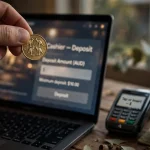
A deposit begins with the operator displaying an account address for receiving Bitcoin. The person making the transfer copies that address into their wallet, enters the amount, checks the destination and sends the transaction. The address is the destination recorded in the transfer; it is not a bank-account detail that can be corrected after the payment is made. Because blockchain transactions are irreversible, a mistake in the address can mean the funds cannot be recovered.
Depositing Bitcoin
Copy the Address
Obtain the account address provided by the operator and copy it exactly into your wallet.
Enter Amount and Send
Input the amount of Bitcoin you wish to deposit and broadcast the transaction from your wallet.
Verify Recognition
Wait for the operator to detect the transfer on the blockchain and associate it with your gaming account.
Sending the transaction does not itself guarantee that the operator will recognise it promptly. The wallet can show that a payment has been broadcast, while the casino account still shows no deposit. The operator must detect the incoming transfer and associate it with the relevant account. Deposit recognition can be delayed, and reusing an address or sending less than the amount the operator expects can also lead to a deposit not appearing as anticipated.
If a deposit is missing, compare the destination address and amount in the wallet’s transaction record with the payment details provided by the operator. Do not send another payment simply because the account balance has not updated: first establish whether the original transaction went to the correct address and whether the operator has detected it. Retain the transaction details when contacting support. Never send more money to unlock a withdrawal that is stuck.
A balance displayed for a game is not necessarily a direct display of a fixed Bitcoin amount. Credits are defined within the particular game, and their Bitcoin value can vary with the game’s credit settings and the current BTC price. A specialist review describes this relationship, but it should not be treated as a universal arrangement across operators or games. Check the account and game displays carefully rather than assuming that a credit has the same Bitcoin value everywhere.
A changing Bitcoin price can affect the value represented by a balance even if the number of game credits has not changed. That distinction matters when comparing a displayed game balance with the Bitcoin amount deposited or later withdrawn. The game’s credit unit and the Bitcoin amount are related through the operator’s conversion settings; they are not necessarily interchangeable units.
Bitcoin transfers also incur miner’s fees. These fees vary as network conditions change. A specialist review characterises them as generally small, but the actual fee depends on the transaction and the conditions when it is sent. The fee is a cost of making the network transfer, not an operator’s account-processing fee. Check the wallet’s fee details before sending, because the amount arriving at the destination may be affected by how the wallet handles fees.
To request a Bitcoin withdrawal, the account holder copies a receiving address from their own wallet and enters it in the operator’s withdrawal form. The address must be checked before submission: an incorrect destination can make the transfer unrecoverable. The form submission is a request to the operator, not proof that Bitcoin has already been sent.
After the operator approves and processes the request, it must create and broadcast a Bitcoin transaction. Only then is there a network transfer to follow. A specialist review reports that most Bitcoin withdrawals are completed within an hour, but that is a report from a particular type of source, not a guarantee or a reliable expectation for every request. The elapsed time can include operator handling as well as the transfer itself.
A delay before a transaction appears on the blockchain points to a different stage from a delay after it has been broadcast. Withdrawal requests may wait in an operator’s approval queue, be held while required account checks are incomplete, or be processed in batches during business hours. In those cases, the Bitcoin network cannot complete a transaction that the operator has not yet sent. Once a transaction has been broadcast, the operator’s processing queue is no longer the same issue as the network’s handling of that transfer.
For a delayed withdrawal, check whether the request is still marked as pending or whether the operator has supplied a transaction record. A pending request indicates that operator-side processing may not be finished; a broadcast transaction can be checked using its transaction details. Do not make an additional deposit to release a pending payment. These steps help identify the stage of a delay, but they do not guarantee that a withdrawal will be approved or recovered.
Yes, you can play free pokies without staking Bitcoin. Real-money online casino games for people in Australia are prohibited under Australian law, and using Bitcoin does not change that.
You may be asked for basic information when registering, and additional checks can be triggered at your first withdrawal or after cumulative deposits of AUD 2,000–5,000. Crypto checks may include signing a message from your deposit address or showing the sending transaction in your wallet.
For real-money play, you need Bitcoin acquired through an exchange, and Bitcoin transfers incur a miner’s fee that is usually very small but varies over time. The amount of Bitcoin needed depends on the game’s credits and the current Bitcoin price.
The operators discussed hold offshore licences, such as from Curacao eGaming or the Anjouan Gaming Authority, but those licences do not authorise them to offer real-money casino games in Australia. Australian consumer protection laws do not apply to these offshore operators.