A practical guide to confirming venue access and understanding what machine information, opening hours and online-pokies claims actually establish.
A venue’s status can change after information has been published. A listing that says a place is open, a search result with recent-looking details or an old photograph does not confirm that you can enter today. Treat a Tasmanian venue’s status as unconfirmed until you have checked it with the venue directly.
Start by identifying the exact venue, not just the town or area. Similar names, multiple entrances and outdated listings can lead you to the wrong place. Check that the address and phone number on the venue’s own website match the place you intend to visit. If you find a listing on a map or directory, use it as a lead, then look for a current contact method supplied by the venue itself.
The most useful check is a direct confirmation on the day you plan to go. Call the venue and ask whether it is open to visitors at that time. If you need access to a particular area, ask about that separately: a venue being open does not, by itself, establish that every part of it is available. A brief, specific question is more useful than asking only whether the venue is “open”, which could be answered without clarifying what you need.
If nobody answers, do not treat the unanswered call as evidence either way. Try another contact method listed by the venue, such as its official website or a current public notice. If the venue has an official social-media account, check for a recent closure or service update, but distinguish a dated post from a live confirmation. A post can remain visible long after circumstances change.
Look at when a notice was published or updated. A result displayed prominently is not necessarily recent, and a page that gives regular operating information may not reflect an unexpected closure. If the date is unclear, the notice concerns a different day, or two official channels disagree, contact the venue rather than choosing the answer that seems more convenient.
 Pokies in Adelaide: Venues, Randomness and RulesLearn how RNG independence and long-term RTP differ, alongside venue hours, local gaming rules and the legal context for online pokies in…
 Pokies in New South Wales: venues and accessLearn how venue hours differ from gaming-area access and machine availability, and how to assess online access and location claims across NSW.
Pay attention to the type of information each channel provides. A map listing may give a phone number or general business details; it may not confirm current access. A venue’s own announcement may describe a temporary change but omit whether it has since ended. A third-party directory can help locate contact details, but it should not replace confirmation from the venue.
If you cannot reach anyone, make the uncertainty part of your decision. You can wait for confirmation, check again shortly before leaving, or choose not to travel until the venue responds. Avoid relying on a stranger’s recent comment as the final word: it may refer to another day, another entrance or a different place with a similar name.
“Open” can mean different things. You may want to know whether the venue is admitting visitors, whether a particular service is available, or whether a specific area can be accessed. State what you need when you call. This reduces the chance of receiving a technically correct but unhelpful answer.
For example, a venue may be open for one purpose while access to another area is restricted. A private function, maintenance, a temporary closure or a change to entry arrangements can affect what a visitor can do. Ask about the relevant access directly rather than inferring it from a general business listing.
The same approach applies when a result suggests that pokies are available early, late or at a particular time. A time shown online is not a real-time status update. Confirm the date and the access you are asking about with the venue; do not assume that a general listing proves the current position. Searches for “open now” can be especially misleading when the listing’s location, time zone or update status is unclear.
Keep the answer tied to the time you asked about. A confirmation given earlier may no longer describe the situation when you arrive, particularly if the venue has announced a temporary change. If your plans depend on access, check again before setting out. You do not need to collect multiple vague assurances; one clear, current answer from the venue is more useful than several undated listings.
A search result that pairs “Tasmania” with a venue name does not prove that the place is in Tasmania, that it has pokies or that it is open. Confirm the venue’s identity and address first, then verify its current status through its own contact channels. Do not infer that a similarly named business is connected to the place you are looking for.
This is also why a broad search for a named casino or club should not be treated as confirmation of a Tasmanian venue. A result may refer to a different state, an unrelated business or a page that has not been updated. Check the address and the venue’s own details before relying on it.
For a useful check, record only what matters: the venue you contacted, the time of confirmation and what access was confirmed. If those details are not clear, you still do not have a dependable answer. When current status cannot be confirmed, the safest assumption for planning is that it remains unknown—not that the venue is open.
A pokie’s return setting and the result of a spin describe different things. The return setting is a game configuration; a spin is a single outcome produced through the game’s random-number process. Neither tells you what the next spin will do, and a result you have just seen does not reveal whether the machine is “due” to pay.
Each spin is generated independently. In practical terms, the outcome of one spin does not make a particular outcome more or less likely on the next. A run of wins does not establish that another win is imminent, and a run of losses does not mean a win is owed. The sequence may look as if it has a pattern, but recent results do not give you a reliable way to predict the next one.
This matters when comparing claims about the best-paying pokies in Tasmania. A machine’s recent performance, a story about a large win, or a short session’s results cannot establish its return setting. Those observations describe particular outcomes, not the configuration or expected behaviour over time. A venue’s machines should not be ranked from anecdotes or from isolated results.
Return to player, often shortened to RTP, is a theoretical measure associated with a game setting. It describes the share of wagered money a configuration is designed to return over a very large number of plays. It is not a promise that an individual player, session or machine will return that proportion. Actual results over a limited number of spins can differ substantially from the theoretical measure because every spin has its own random outcome.
A specialist review reports that some game providers give casinos a choice of more than one RTP configuration for a particular pokie. If that applies, the same named game can be set to different return percentages at different casinos. The game title alone therefore cannot establish the setting used at a particular venue in Tasmania. A description of a game elsewhere, even if it names an RTP, does not prove that a local machine uses the same configuration.
To assess a return claim, identify what it refers to: the game, the specific setting, and the venue or machine to which the claim applies. If one of those links is missing, the claim cannot answer what is configured on the machine you are considering. A general game description may help you recognise the title, but it is not evidence of a venue’s exact setup.
Return to Player (RTP)
Return to player is a theoretical measure of the share of wagered money a configuration is designed to return over a very large number of plays, not a guarantee for any individual session.
A visible sequence of outcomes is only a small sample. It can look unusually generous or unusually poor without changing the independence of future spins. Nor does a busy machine’s past activity tell you whether its next result will be a win. There is no dependable way to infer a machine’s return setting from what it has paid recently.
The same limitation applies when someone calls a particular game “best paying”. That phrase may refer to a theoretical setting, a personal experience or a memorable payout. Unless the statement identifies the basis for the comparison and the setting in question, it does not establish that the game offers a better return at a particular Tasmanian venue. A large payout is a single outcome, not proof of a more favourable configuration.
For the same reason, a game name is not a complete comparison. If the title is available in different configurations, knowing the title still leaves the setting unresolved. And even when a setting is known, it describes theoretical return over extensive play rather than a dependable result for your own session.
When you encounter a return claim, separate what it can establish from what it cannot:
These distinctions are useful whether you are comparing Tasmania casino pokies, considering a venue in a city centre, or trying to understand a game description. They do not produce a verified ranking of the best pokies in Tasmania. They show why a ranking based only on a game’s name or recent results would claim more than those details support.
A map result described as “near the airport” or “near the CBD” is only a starting point. The label may refer to a broad area, not a venue you can reach easily from your actual starting point. Before setting out, identify the exact venue and check its street address against your route.
Start with the place you will depart from. Tasmania airport searches can be ambiguous if you have not specified which airport or town you mean. A result near one airport may be irrelevant to a journey beginning elsewhere on the island. Likewise, a venue described as central may be in a different city from the CBD you have in mind. Match the venue address to your actual arrival point or central district rather than relying on a general label.
Then check that the result refers to a physical venue, not an unrelated business, an outdated listing or a place with a similar name. Compare the venue name and address across its own current information and a map. If those details do not match, pause before planning around the result. A pin on a map alone does not establish that the venue is the destination you intended.
Planning Your Trip
Identify the Destination
Find the exact venue name and street address, then match them across the venue's own site and a reliable map.
Establish Your Starting Point
Determine your precise departure location, such as a specific airport terminal or CBD address, to avoid ambiguous search results.
Map the Route
Check the actual road access and public transport connections rather than relying on the distance shown in a search result.
Verify Final Details
Save the full address and confirm it with your transport provider or navigation system before starting the journey.
Once you have a confirmed address, work out the journey from the specific point where you will start: the airport, accommodation, workplace or another location in the CBD. Look at the route itself, not just the distance shown in a search result. Road access, transfers and the position of the entrance can affect how practical a trip is. If you will use public transport, check the route and any connections separately; do not assume that a short distance on a map means a direct trip.
For “pokies near me” searches, location settings can also affect which results appear. Confirm that the map is using your current location, then check the address before navigating. If your location is approximate, the results may be centred on the wrong part of town. A search for northern Tasmania venues has the same limitation: a regional label does not tell you how far a result is from your starting point or which route reaches it.
Keep the destination details available while travelling. Save the venue name and full address, and compare them with the navigation destination before you begin the trip. If someone else is arranging transport, give them the address rather than a description such as “near the airport” or “in the CBD.” Those phrases can point to different places depending on the starting point and the city.
Separate the location check from other decisions about the visit. Confirming a route tells you where a destination is; it does not establish whether the venue is operating at the time you plan to arrive. Check that separately before leaving, and use the venue’s own current information when doing so. This prevents an approximate map label from becoming the basis for a trip to the wrong place.
Information recorded about a venue describes its operations as a whole. It can help you understand what a venue reports about its machines, staffing and gambling-related incidents, but it does not tell you what will happen at a particular pokie. A venue-level figure cannot establish the outcome of your session or serve as a ranking of individual machines.
Read each item according to what it measures. A count of machines, for instance, describes the venue’s scale; it does not show that every machine is available or operates in the same way. A record of incidents concerns events involving patrons and staff, not a prediction about a future visit. Before drawing a conclusion, check the reporting period, the definitions used and whether the information applies to one venue or a wider group. Without that context, figures can look more precise than they are.
There is also a distinction between a venue’s records and information about a specific pokie. Venue reporting can describe policies, staffing or recorded events. It cannot, by itself, verify a claim about a particular machine or guarantee a particular experience. Treat a general venue description as evidence about the venue only to the extent that its scope and source are clear.
A report published by regionriverina.com.au describes a requirement commencing on 1 July: venues with more than 20 gaming machines are to have a dedicated responsible gambling officer (RGO) on duty while those machines are operating. The threshold and the operating condition matter. The report does not describe this as a requirement for every venue regardless of machine count, nor as a role that must be present when the machines are not running. If you are assessing a particular venue, do not infer its machine count or staffing arrangements from a general description; look for information that explicitly identifies that venue and the period it covers.
Attention: A venue's machine count or staffing arrangements cannot be inferred from general descriptions; you must look for information that explicitly identifies the specific venue and period.
The same report says venues are to keep a gambling incident register. Its purpose is to record occurrences, including situations where a patron’s behaviour indicates possible gambling harm. Such a register is an operational record, not a public scorecard of venues or a measure of how an individual patron will be treated. The presence of a recording requirement also does not reveal the contents of a venue’s register.
When comparing Tasmanian venues, separate verifiable venue-level details from conclusions that the figures cannot support. A report may tell you something about staffing rules or the way incidents are recorded; it does not establish that one venue is the best choice, that a particular machine is favourable, or that a session will go a certain way. Check that the information names the venue, explains its scope and is current enough for the decision you are making.
A question about pokies aboard the Spirit of Tasmania is different from a question about playing online. One concerns what may be available as an onboard amenity; the other concerns a gambling service reached through a website or app. The distinction matters because information about online gambling rules cannot establish what facilities a ship provides.
If you are considering a trip because you expect to play pokies onboard, confirm the ship’s current amenities directly with the Spirit of Tasmania operator before making plans. A name, photograph, passenger discussion or reference to a casino elsewhere does not establish that pokies are available on a particular sailing. Treat the vessel and any Tasmanian casino or club as separate destinations: information about one does not verify the facilities at another.
The same care applies to references to “Crown” and Tasmania. A casino name in a page title or conversation is not proof that a venue with that name operates in Tasmania, or that it has any connection to the ship. Check the exact venue and location with the organisation responsible for it rather than inferring a local venue from the wording.
Online play has a different legal position. The Interactive Gambling Act 2001 makes it illegal for companies to offer real-money online pokies to people in Australia without a domestic licence. No such licences have been issued, so there is no Australian-licensed online casino. A website’s claim that it serves Tasmanian players, or offers a welcome deal, does not change that position.
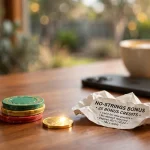
A “no deposit” offer also does not establish that a service is lawful or that you can withdraw winnings. The promotional wording describes an offer, not an Australian licence. Before treating any online casino as a reliable source of winnings, consider what happens if the operator refuses to pay: Australian players have no legal recourse in Australia against an offshore casino in that situation.
These are separate checks, not interchangeable evidence. Confirm onboard facilities with the ship operator; do not use that answer to infer anything about online play. Conversely, an online casino’s claims do not show that pokies are available on the Spirit of Tasmania or at a Tasmanian venue. If your plans depend on either, establish the specific service and its status before travelling or providing payment details.
Legal Risk
There are no Australian-licensed online casinos. Using offshore sites means you have no legal recourse in Australia if the operator refuses to pay your winnings.
A venue’s published opening hours describe when it says the premises are open to visitors. They do not, by themselves, establish that pokies are operating throughout that period. Treat these as separate pieces of information: the venue’s schedule concerns access to the premises; machine operation concerns whether gaming is available at a particular time.
This distinction matters when you see a claim that a venue is open around the clock. It may describe the venue’s general access, not continuous operation of every service inside it. A schedule can therefore help you understand when the premises are expected to be open without answering whether pokies are running during a particular part of that schedule.
Read the details attached to the hours, not just the headline. Check whether the schedule refers to the whole venue or a particular area, and whether it gives separate times for gaming. If it does not distinguish those things, do not treat the general opening time as confirmation of machine availability. A listed schedule is a statement about planned hours; it is not a live indication that machines are operating at the moment you intend to visit.
There is also a regulatory detail that connects machine operation with staffing. A report by regionriverina.com.au describes a requirement applying from 1 July: venues with more than 20 gaming machines are to have a dedicated responsible gambling officer (RGO) present while those machines are in operation. The condition is tied to operating machines, rather than simply to the venue being open. So the two states—premises open and machines operating—should not be collapsed into one.
For a practical reading, separate the information into three questions: when the venue says it is open, whether it publishes distinct gaming hours, and whether those hours answer the time you have in mind. If only general opening hours are provided, they tell you about the premises but do not settle the machine question. If gaming hours are stated separately, use that schedule as the venue’s stated operating window, while recognising that a schedule is not confirmation of live conditions.
This is the useful way to interpret Tasmanian pokies opening hours: regard the published times as a schedule for the thing they explicitly describe. Do not infer machine operation from a general venue timetable, or assume that a claim of 24-hour access means continuous pokies. When the distinction is not made clear, the schedule cannot support a more specific conclusion.
If you’re looking for pokies in Tasmania in 2026, a clear reference point can help you decide which options are worth checking further. Use this list to review the limited operator details available before making your choice.
7Bit Casino
7Bit Casino is listed as operating under a Curacao license, with Dama N.V. as its operator.
SpinsUp
SpinsUp is associated with Dama N.V. and holds Curacao Gaming Control Board license OGL/2023/174/0082.
Playfina Casino
Playfina Casino has been associated with Hollycorn N.V. since 2017 and holds a Curacao eGaming license. Its minimum deposit is A$20–30, depending on the offer.
Ricky Casino
Ricky Casino lists crypto payouts as taking under an hour and PayID payouts as taking 1–3 business days. The minimum deposit is A$20, or A$30 to qualify for the bonus.
Golden Pokies
Golden Pokies is listed with a Curacao license. No further operator details are provided here.
Vegaz Casino
Vegaz Casino holds Curacao license OGL/2024/1335/0780 and has a minimum deposit of EUR 20.
Neospin
Neospin is associated with Hollycorn N.V. and holds Curacao Gaming Control Board license OGL/2023/176/0095.
JustCasino
JustCasino is listed as holding a Curacao Gaming Control Board license. No other verified details are provided here.
Bizzo Casino
Bizzo Casino is associated with TechSolutions Group N.V. and holds a Curacao Gaming Control Board license.
SkyCrown
SkyCrown holds a Tobique Gaming Commission license. Its listed payout times are around 10–15 minutes for crypto and 1–5 days for fiat, and its minimum deposit is A$30.
A description of a pokie can tell you something about its design, but it does not establish the exact settings of a machine at a particular venue. A game’s name or appearance is not enough to identify its return setting, maximum bet or maximum cash payout. Those details need to be confirmed for the specific machine, rather than inferred from a general description of the game.
A specialist review reports that some game providers let casinos choose between different return settings for the same pokie. As a result, information about one version of a game does not necessarily describe the version installed elsewhere. Even when the title matches, you would need information tied to the particular machine or casino to know which setting applies. A figure shown in a general game description should not be treated as confirmation of a Tasmanian venue’s configuration.
Return information also needs to be read as a property of a setting, not a forecast of what will happen during a visit. It cannot tell you what a particular machine will pay in a session. Each spin is generated separately by a random number generator, so the result of an earlier spin does not determine the next one. A run of wins does not make a loss due, and a run of losses does not make a win more likely on the next spin.
This distinction matters when comparing claims about pokies in Tasmania. A game description may help you understand what a title offers, while a machine-specific specification would be needed to establish its settings. Neither a title nor a reported return figure proves that a particular venue has that pokie, or that its machines use the same configuration as machines elsewhere.
Claims about betting limits and cash payouts require the same care. A maximum bet is not established simply because a game’s name or general rules are available; the applicable machine settings matter. Likewise, a statement about a maximum cash payout needs to identify what it applies to. Do not assume that a figure associated with a game describes every machine carrying that title.
When checking information, look for the exact game version and a clear indication of what the stated setting or limit covers. If those details are absent, the claim may be useful as general background, but it cannot verify the configuration of a particular pokie. This keeps a game description separate from evidence about an individual machine.
A phone does not change the legal status of an online pokie. The relevant distinction is whether a company is providing real-money online casino games to people in Australia, not whether they access them through a mobile app, a browser or a computer. Under the Interactive Gambling Act 2001, operators cannot legally offer those services to Australian residents without a domestic licence. No such licences have been issued, so there is no Australian-licensed online casino.
This means searches for online pokies in Tasmania do not point to a locally licensed online casino option. A website’s availability on a device, or its use of Australian terminology, does not establish that it is authorised to provide real-money casino games here. Nor does a claim about high payouts establish that the service has a domestic licence or that an advertised outcome will occur.
The legal rule is directed at operators rather than individual players. Australians are not criminally liable simply for playing on an offshore site that accepts them. That distinction does not make the service Australian-licensed, however, or give you the protections and remedies that a domestic licensing system would provide.
The practical risk is clearest if a payment or account dispute occurs. If an offshore casino refuses to pay winnings, Australian players have no legal recourse in Australia to require that casino to pay. A site may describe its own rules or refer to an overseas licence, but those statements do not create an Australian licence or an Australian route to recover withheld winnings.
BetStop has a limited scope: it applies to Australian-licensed operators and does not bind offshore sites. It should not be treated as a way to block access to every offshore gambling service.
BetStop Limitation
BetStop only applies to Australian-licensed operators and does not bind or block access to offshore gambling sites.
For searches mentioning central Tasmania or a particular town, keep the online question separate from the location of land-based venues. A result that describes a site as serving Tasmania is not evidence of a Tasmanian venue, and a mobile page is not proof of Australian authorisation. Before relying on any claim about online play, identify whether it concerns an operator, a physical venue or simply a website accessible from your device. These are different things, with different legal and practical consequences.
A central Hobart address does not, by itself, show that a venue has pokies. The word “club” can refer to different kinds of organisations, and a listing that describes a club or social venue does not establish that gaming machines are available there. Treat the venue’s exact identity and its location as separate details to confirm.
Start with the venue’s own current information. Check that its name matches the place you intend to visit, then compare the street address with a reliable map. Similar names, branches and nearby businesses can make a broad CBD result misleading. If the information does not clearly connect the address to the venue, contact the venue directly and ask whether that specific site has pokies. Do not rely on a general description or a map category as confirmation.
This is also a useful way to assess claims about the “best” pokies in central Hobart. A venue name, a club label or a list of nearby places does not establish which machines are available at a particular address. Before making a decision, separate what is confirmed about the venue from opinions or promotional language about its games.
If you are checking whether a club has pokies, ask a precise question: does this named venue at this address have gaming machines? That avoids confusing a club’s general activities with what is offered at one location. Keep the answer tied to the specific site; information about one branch should not be assumed to apply to another.
Self-exclusion is a separate matter from finding a venue. Deposit limits, loss limits, session time limits and self-exclusion are responsible-gambling tools, but their availability as general tools does not confirm how a particular Hobart venue handles a request. If self-exclusion is relevant to you, contact the venue before attending and ask what process applies there. Do not assume that a venue’s name, location or online listing explains the process.
A reliable check therefore has two parts: confirm the exact address, then confirm directly that the named venue offers pokies. If either point remains unclear, do not treat a broad CBD or clubs listing as proof.
“Cashless” can describe different parts of a payment process, so it is important to identify what a claim actually refers to. PayID is not a pokie or a feature that establishes how a venue’s machines work. It is an alias layer on Australia’s New Payments Platform (NPP), allowing a bank transfer to be addressed using an email address, mobile number or ABN. The NPP is supported by all major Australian banks and uses end-to-end encryption.
That describes the transfer mechanism, not the destination or what happens after money arrives. A PayID reference on a payment page does not prove that a gambling service is licensed to operate in Australia. Nor does it show that a particular pokie’s return setting is disclosed, or that the setting is the same at different venues. Payment information and game information answer separate questions.
The same distinction applies to searches for cashless pokies in Tasmania. A reference to PayID tells you about a way to identify a bank transfer; it does not confirm that a Tasmanian venue accepts it, that its machines are cashless, or that a named location has pokies. Check claims against the specific venue or service they concern rather than treating a payment option as evidence about the machines.
If a page uses PayID as a sign that its games are fair, transparent or officially approved, that conclusion does not follow from the payment method. The NPP’s bank support and encryption describe the payment network. They do not certify a gambling operator or verify game settings. Keep those categories separate: a payment alias helps route a transfer, while venue details and game disclosures require their own evidence.
Yes, Australians can legally play on offshore sites that accept them, but it is illegal for companies to offer real-money online pokies to Australians without a domestic licence, and none have been issued. If an offshore casino refuses to pay, you have no legal recourse in Australia.
It is the amount you must bet before bonus winnings can be withdrawn, calculated as a multiplier. For example, a $500 bonus with a 40x requirement means you must place $20,000 in bets.
Yes, PayID is treated like any other qualifying deposit method at the recommended sites.
Compare the bonus with the total betting required to unlock it, and check for cash-out caps on free-spin winnings. For example, a $500 bonus with a 40x requirement requires $20,000 in bets; if the requirement applies to a $500 deposit plus the $500 bonus at 35x, it requires $35,000.
Yes, some game providers let casinos choose among multiple RTP settings for the same pokie, so its return percentage can differ between casinos.